
WNV tries to answer the question of whether manual washing or automated washing makes sense for HGV and commercial vehicle fleet operators.
As tech evolves, budgets get tighter and legislations become increasingly more intense, many fleet operators are considering switching to a consistent, automatic vehicle washing system.
But with that comes a cost, and a consideration on whether the initial outlay is worth the longer term benefits.
So when does it make sense to switch to an automatic fleet washing system?
Manual Truck Washing, Flexibility and Considerations
Manual washing, with a high-pressure jet wash system, is extremely useful for smaller fleets, or those fleets that need an occasional cleaning schedule instead of a regular rota. It can also be very useful for unusually-shaped vehicles, or to help with specific site requirements and restrictions.
This approach requires an operator to perform the wash, which can take up valuable staff time, and the consistency of the wash can differ from operator to operator. It also involves the manual handling of cleaning chemicals – not to mention the high-risk pressure washing equipment.
It does, ultimately, offer more flexibility for each depot, especially when the fleet numbers are smaller.
Automated Truck Washing, Consistency and Throughput
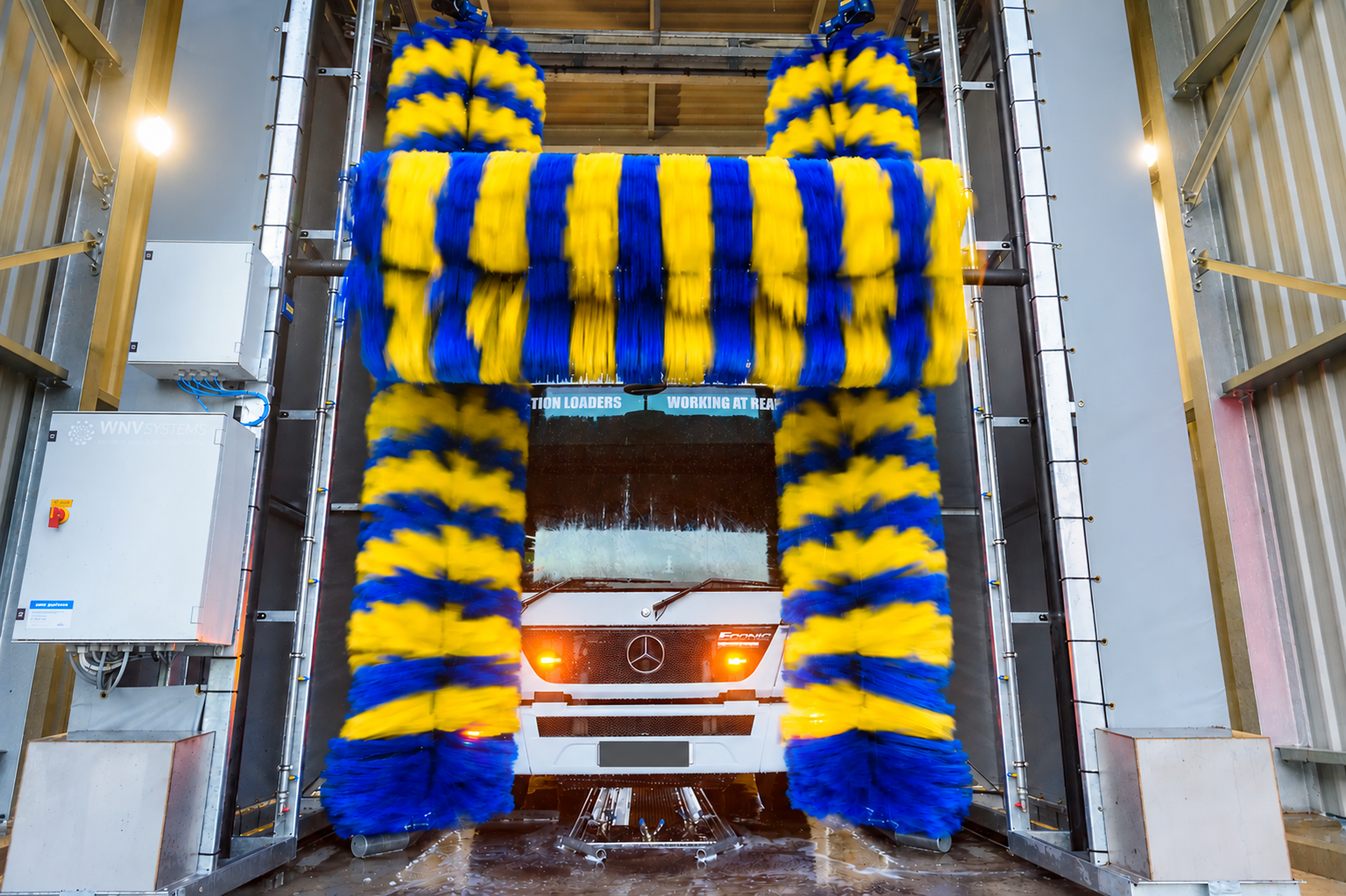
What is an automated truck washing system? Well, WNV’s three brush rollover is like a forecourt car wash, but on steroids. As the name suggests, three rotating brushes clean the whole body of a vehicle, including the roof.
The truck is positioned in a designated wash bay, whilst a gantry moves up and down the vehicle on a pre-programmed cycle, which is fully adjustable and programmable for any specific vehicle.
An automated system improves the consistency of a wash performance, give a more accurate and predictable wash time and reduces reliance on manual labour, keeping staff freed up for other tasks whilst also removing any added risk. In essence, it adds a defined process that can be incorporated into any depot routine.
It’s a more costly option up-front, but there is an argument that the wash will pay for itself in the not-too-long term.
Factors to consider
Although each depot has its own specific requirements, there are a number of areas that are worth considering and comparing before switching to an automated system.
Firstly, and possibly the most important factor is labour requirements. It’s worth working out your current schedule and routine, including vehicle preparation and finishing, and comparing that to what would be required for an automated system.
Cleaning consistency is another important area. Can your depot’s required cleaning standard be achieved reliably across different operators, vehicles and shifts? If this is important to you, an automated system may be the way to go.
The third big consideration is site space, and how an automatic system could fit into the space you have. An automatic system needs a dedicated wash bay, easy vehicle access, good drainage and space for all associated equipment. A manual process does not need these things to as great a degree.
Things like vehicle throughput – whether you’re washing an average of 10 vehicles or 100 vehicles would need to be taken into consideration, as well as the maintenance of an automatic wash.
When Does Automated Truck Washing Make Sense?
Simply put, if your depot is looking for a more reliable, predictable exterior vehicle washing schedule, across a large number of vehicles, an automatic system may be for you.
Significant savings on staff time devoted to a repetitive task could be negated, and a more consistent clean could be achieved. But, there must be a suitable site available.
Considering a Three-Brush Rollover Truck Wash?
If you are considering an automated truck wash system, WNV Systems is here for you. Our dedicated team of experts can help you with assessing your requirements and needs, and will talk you through each and every step of the process, from quoting, to installation, to handover.
The best solution, however, is the one that meets your specific site’s requirements, operating schedule and budget.
If you would like to explore your options, contact WNV Systems at www.wnv-systems.com, email sales@wnv-systems.com or call us on 020 86415601. Our team would be delighted to hear from you.